MAKE / TECHNIQUE

How to Make Rolled Ice Cream

Use the right base, a truly cold flat surface, a thin layer, and decisive scraper pressure. Most failed rolls trace back to one of those four variables.

Editorial review updated July 31, 2026
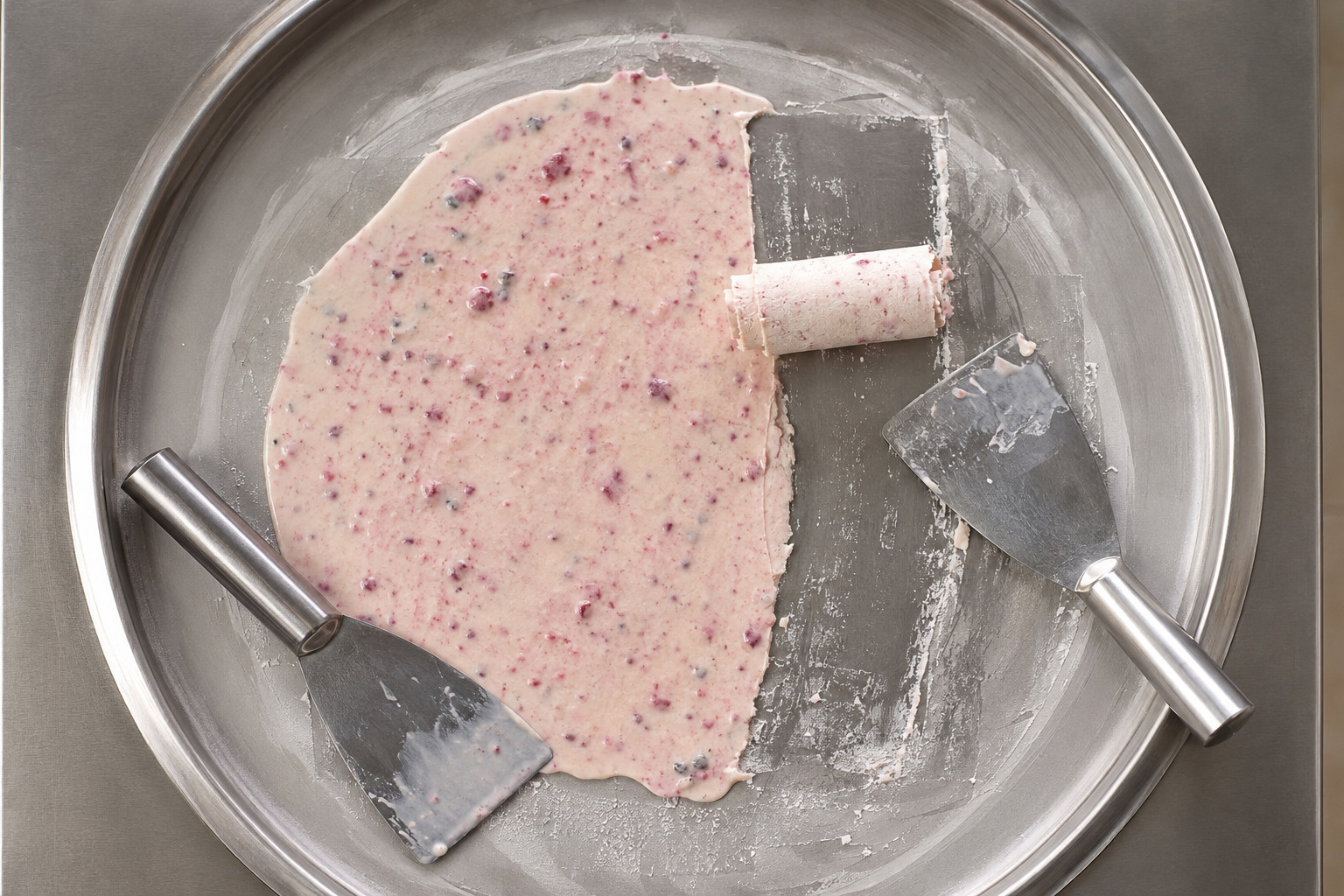
How to make rolled ice cream by spreading cold cream base thinly on a chilled stainless-steel plate with two scrapers
Technique illustration: a thin layer, cold surface, and controlled scraper pressure determine whether clean rolls form.

Choose Your Method

LOW COST

Metal-pan method

Accessible, but depends heavily on freezer temperature and loses working time quickly.

EASIER REPEAT

Freezer tray

A purpose-shaped passive tray can simplify handling but still needs refreezing.

ACTIVE COOLING

Powered cold tray

Longer working time and repeat batches; verify usable area and recovery.

SERVICE

Commercial machine

Built for throughput, not automatically appropriate for a home kitchen.

The Working Sequence

  • Pre-chill the base, tools, and metal surface.
  • Use a modest pour; a thick pool freezes unevenly.
  • Add finely sized mix-ins and work them into the base.
  • Spread into a thin rectangle with few thick edges.
  • Wait only until the surface is firm—not brittle.
  • Hold the scraper square to the sheet, angle it forward, and push steadily.
  • Plate immediately; the thin rolls soften fast.

Why Rolls Fail

Soft or smearing

The surface or base may be too warm, the layer too thick, or the formula too high in unfrozen liquid.

Crumbling

The sheet may be overfrozen, too lean, too dry, or weakened by excess chunky mix-ins.

Sticking

The surface may not be ready, the scraper edge may be poor, or the working angle may be too shallow.

Breaking midway

Uneven thickness, a hesitant push, or a warming pan can fracture the roll.

Substitutions Change Behavior

Dairy-free, vegan, and lower-sugar bases can work, but fat, sugar, water, stabilizers, and solids control softness and ice formation. Treat substitutions as formula changes—not one-for-one swaps with guaranteed results.

Safety and Sanitation

  • Keep dairy and other perishable bases properly refrigerated.
  • Sanitize the pan and tools between batches and allergen profiles.
  • Avoid glass surfaces and pans not intended for food or freezer use.
  • Follow equipment manuals and local food-handling rules for commercial service.

Use the Basic Recipe

Keep Moving

Learn the method →Compare machine classes →Plan the business →