Prove the use case
Home experiment, repeat home use, event service, mobile business, and fixed commercial service require different equipment.
BUY / PRIMARY GUIDE
The honest first decision is not which brand wins. It is which machine class matches your volume, space, power, workflow, and tolerance for downtime.
Editorial review updated July 31, 2026
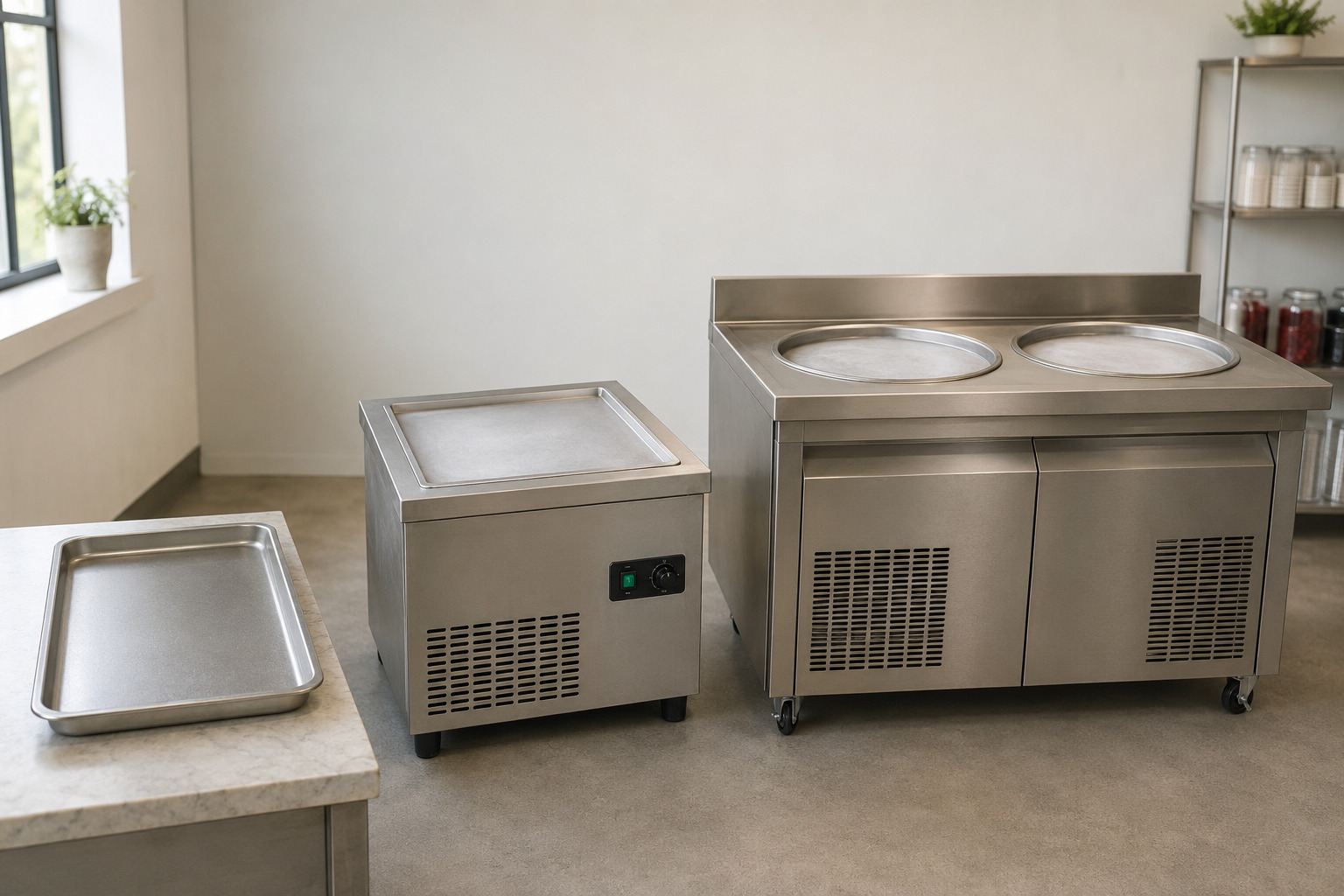
Home experiment, repeat home use, event service, mobile business, and fixed commercial service require different equipment.
A second pan cannot fix slow prep, payment, toppings, weak demand, an untrained operator, or inadequate power.
Reject candidates that fail space, circuit, sanitation, certification, freight, parts, warranty, or repair requirements.
Only equipment that survives the constraints earns a product pathway and conditional verdict.
Prove the recipe and technique on a metal pan or passive tray before buying capacity.
Choose one reliable workflow unless measured queues show the cold plate is the constraint.
Two pans help only when labor, power, preparation, and service space can use them simultaneously.
Weight, generator load, water, refrigeration, transport, and permits can overrule machine preference.
Lowest entry cost; narrow working window and freezer-dependent results.
Purpose-shaped surface; must be refrozen between working sessions.
More repeatability; requires counter space, power, and recovery verification.
Smaller footprint; verify duty cycle and commercial approval.
One-operator workflow with moderate throughput.
Parallel production with higher power, space, cleaning, and cost demands.
This page summarizes the decision. The commercial machine guide contains the deeper product profiles, verification questions, and conditional verdicts.
| Candidate | Pan class | Likely fit | Primary advantage | Rejection trigger | Evidence |
|---|---|---|---|---|---|
| Kolice 21-inch square | Single pan | One operator; moderate workflow | Large square working surface | Parallel production or service proof required | Seller information reviewed |
| Kolice double 22-inch round | Double pan | Two workflows or peak queues | Parallel cold surfaces | Second pan does not solve a measured bottleneck | Seller information reviewed |
| VEVOR 19.7-inch | Compact single pan | Controlled counter or event research | Powered step above passive trays | Electrical, compliance, or service gaps remain | Listing identity verified |
| TECHTONGDA 19.7-inch square | Square single pan | One-operator square-pan workflow | Straight-edge working geometry | Seller or repair pathway cannot be verified | Listing identity verified |
Reserved for documented direct testing.
Claims checked against available technical documentation.
Seller policy or listing checked at a recorded date.
Identified outside evidence informs the analysis.
No hands-on verdict is implied.
Use the machine selector to identify your class, review the landed-cost framework, and apply the commercial inspection checklist before following a product path. The editorial policy explains every evidence label.